Best Local Coding Models You Can Run Offline in 2026
A hardware-honest shortlist of open coding LLMs for offline IDEs: which model classes win for 8GB, 16GB, and 24GB, how to judge agent readiness, and how to load them in Quietly without cloud APIs.
Comparison · 13 min
Best Local Coding Models You Can Run Offline in 2026
A hardware-honest shortlist of open coding LLMs for offline IDEs: which model classes win for 8GB, 16GB, and 24GB, how to judge agent readiness, and how to load them in Quietly without cloud APIs.
Definition
A local coding model is an open-weight language model (often distributed as GGUF) that runs on your machine to explain, generate, and edit code offline—without sending repository context to a cloud coding API.
Leaderboards move weekly. Hardware does not. The “best” offline coding model is the strongest one that still feels interactive on your VRAM, stays reliable for tool-style edits, and does not force you back onto a subscription API.
This shortlist is Quietly-oriented: models you can actually download, quantize, and use inside an offline AI IDE—not abstract API names you cannot host.
We group by job (daily pair-programming, agentic edits, tiny machines) and by memory tier. Names evolve; the selection method stays durable.
How we score offline coding models
Cloud demos optimize for wow. Offline daily drivers optimize for repeatable work. Quietly’s scoring weights the following equally—then breaks ties with hardware fit.
Quietly Offline Coding Scorecard (equal weights).
| Criterion | What “good” looks like | Red flag |
|---|---|---|
| Instruction fidelity | Follows “only change X” without inventing files | Rewrites half the repo unprompted |
| Code locality | Edits match surrounding style and imports | Generic tutorial code ignoring your stack |
| Tool / agent readiness | Clear patch plans; recovers after failed commands | Loops, hallucinated paths, silent assumptions |
| Latency fit | Usable tok/s on your tier at 4k–16k context | Beautiful answers that arrive after you context-switched |
| License / redistribution | Clear open weights for local use | Ambiguous commercial terms for your company |
| Quant stability | Q4_K_M still coherent for coding | Quality cliffs hard below Q5 |
note
Names change; classes persist
In 2026 the competitive classes are typically: efficient 7–9B daily models, 14B “sweet spot” coders, 22–32B strong dense models, and MoE coding specialists with few active parameters. Pick the newest instruct/coder release inside the class that fits your VRAM—see our VRAM guide for budgets.
Best picks by hardware tier
Start here before chasing exotic MoE files.
| VRAM / memory | Primary pick (class) | Secondary pick | Job it wins |
|---|---|---|---|
| 8GB / modest laptop | 7–8B coder/instruct Q4 | Same size Q5 if stable | Explain, small patches, tests |
| 16GB daily driver | 9–14B coder Q4_K_M | 14B Q5 or compact 22–27B Q4 | PR-sized refactors + chat |
| 24GB power seat | 22–32B coder Q4 | 14B Q6/Q8 + long context | Harder reasoning + agents |
| Unified 32–64GB+ | 14B–32B by latency taste | MoE coder if it fits | Laptop-first Apple / big RAM |
tip
Prefer “coder” or “instruct” builds
Base pretrained checkpoints are for research and fine-tuning. For Quietly chat and pair-programming, use instruction-tuned or code-specialized variants. Match chat templates when the runtime asks—wrong templates silently degrade coding quality.
Model classes that dominate offline coding in 2026
Rather than a fragile top-10 that ages in a month, use these classes. When a new Qwen/DeepSeek/Gemma/Mistral coder drops, slot it into the row that matches size—not into every GPU at once.
- Qwen Coder family (including MoE “few active params” variants): often leads agentic tool-use and repo-shaped tasks when quant fits; watch total weight size even when active params look small.
- Strong dense ~14B–32B generalists with coding strength (Qwen / Mistral-class peers): excellent all-round Quietly daily drivers when VRAM allows.
- Efficient ~7–9B MTP / small dense coders: best 8GB and travel laptops; maximize speed and iteration count.
- Gemma-class multimodal instruct: useful when screenshots/UI dumps matter alongside code—not mandatory for pure backend work.
- DeepSeek-class reasoners (when locally runnable): strong for algorithms and hard debugging; confirm license and hardware reality before promising them to a team.
Quietly recommendation matrix (product-agnostic classes → workflow).
| If you need… | Favor this class | Quietly tip |
|---|---|---|
| Fast autocomplete-like chat | 7–9B coder Q4/Q5 | Keep context short; iterate often |
| Balanced pair-programming | 9–14B coder Q4 | Default Quietly coding model tier |
| Multi-file agent plans | Coder MoE or 22–32B Q4 | Approve each file/terminal action |
| Privacy + air-gap after setup | Any local GGUF you host | Download once; then disconnect |
| Docs + UI screenshots | Multimodal instruct mid-size | Only if VRAM leftover after weights |
warning
MoE marketing vs disk reality
“Only 3B active parameters” can still mean a huge on-disk MoE. Quietly (and your GPU) must load the expert weights you quantized. Always check GGUF size against usable VRAM—not the active-param slogan alone.
Agentic coding offline: what to test before you trust a model
Quietly can propose file creates, edits, patches, deletes, and shell commands—you approve each action. Models that hallucinate paths or invent APIs waste that loop. Run this 15-minute eval on every candidate GGUF:
- Single-file precision: “Add a null check only in function X—show a minimal diff.” Reject models that rewrite the module.
- Import honesty: ask for a helper that uses an existing util in your repo; fail if it invents a fake package.
- Failure recovery: deliberately point at a missing file; good models ask or stop—bad models fabricate content.
- Command caution: for shell proposals, prefer models that echo exact commands and scope (cwd) clearly.
- Latency under attachment: attach a 200–400 line file; if replies stall, downsize before blaming the IDE.
tip
Approval is a feature, not a footgun
Local agents are powerful because mistakes stay on disk you control—but you still review diffs. Quietly’s approve-each-action design pairs best with models that propose small, reviewable patches.
Recommended Quietly loadouts (copy these)
Opinionated starter kits—swap in the newest instruct/coder release inside each class.
| Profile | Model class | Engine bias | Notes |
|---|---|---|---|
| Laptop 8GB | 7–8B coder Q4 | Llama.cpp / GGUF | Speed > peak IQ |
| Dev desktop 16GB | 14B coder Q4_K_M | Llama.cpp first | Best Quietly default |
| Workstation 24GB | 22–32B coder Q4 | GGUF; try AirLLM for large HF | Enable longer context carefully |
| Agent experiments | Coder MoE that fits | Engine that loads it cleanly | Keep approval on; short loops |
| Chat + light code | General instruct 8–14B | Any local engine | Separate from heavy agent model |
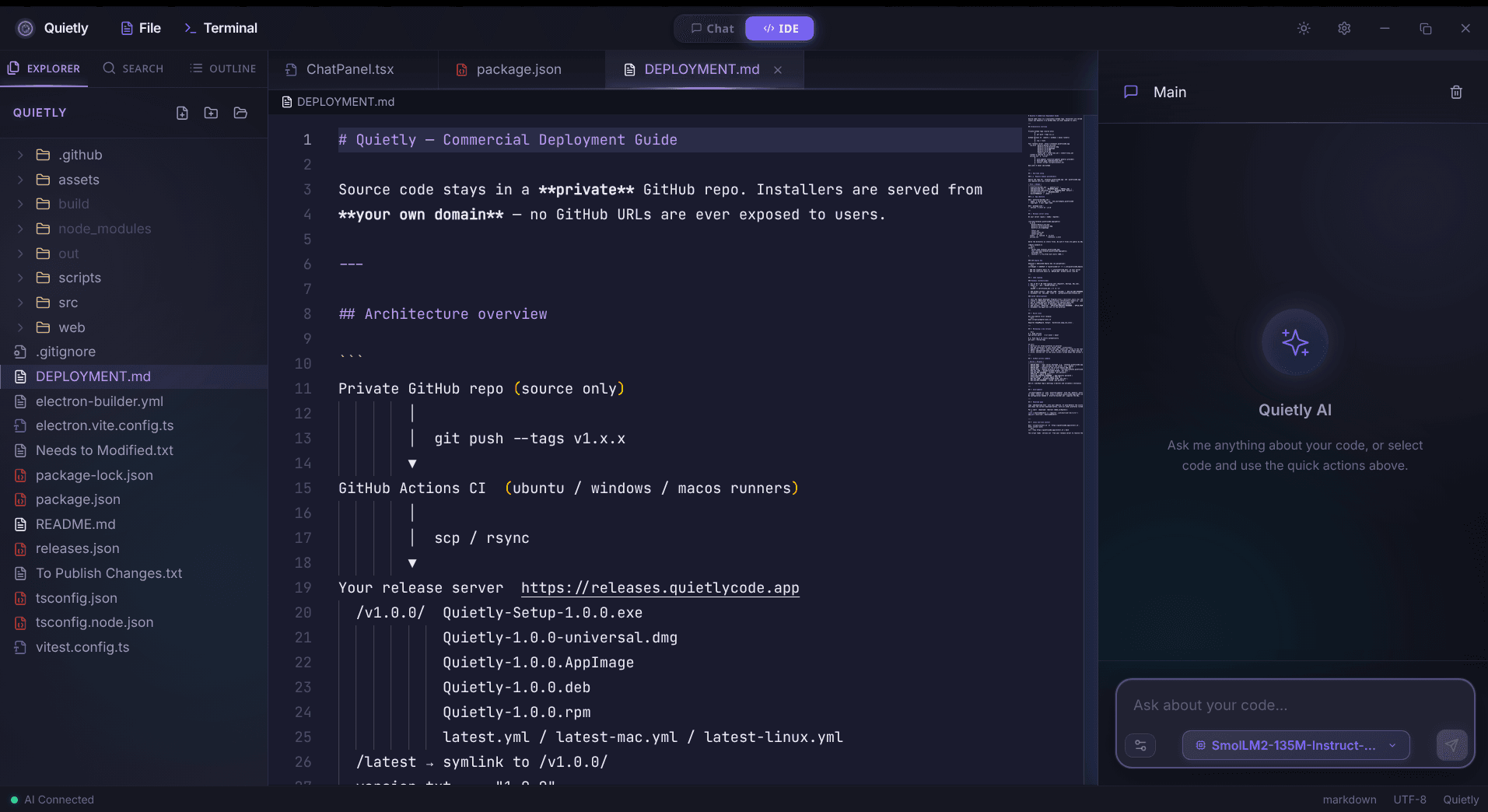
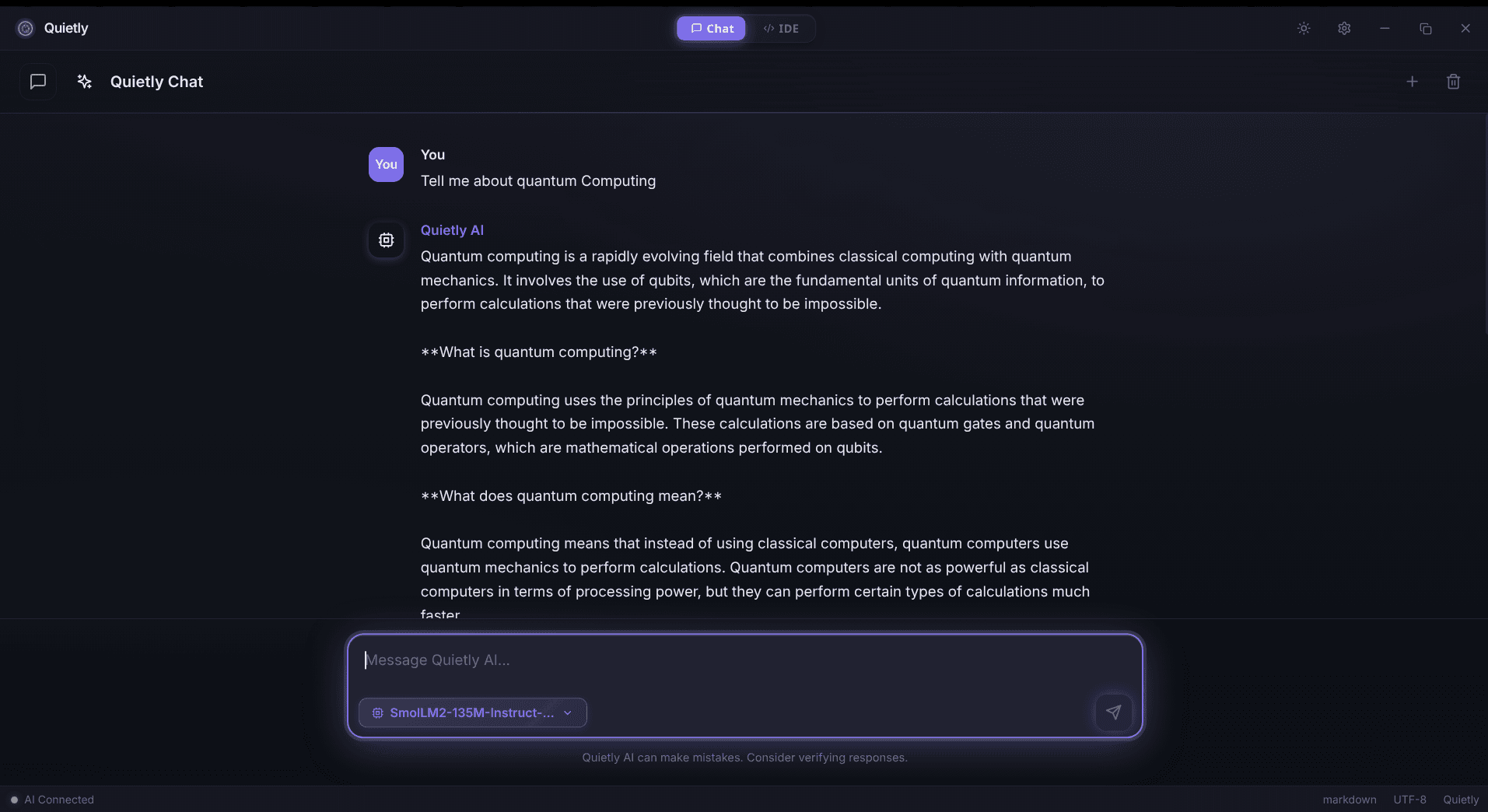
Use Quietly’s Model Hub to download or import GGUF/HF folders, tune context/temperature/threads, then verify offline. Companion reading: quietlycode.org/blog/vram-guide-local-coding-models-8gb-16gb-24gb and quietlycode.org/local-ai-coding.
What not to chase in 2026
- Cloud-only frontier names that have no honest local weights.
- Unquantized 70B+ demos on a 16GB card “just to see.”
- Weekly model hopping that resets your prompt habits and template settings.
- Assuming open-source UI + paid API key equals “local coding model.”
- Ignoring license text for commercial products shipping your company code through a model’s training policy—local inference still needs a redistribution-safe weight license.
note
Quietly’s product promise ≠ model brand
Quietly is the offline IDE + chat shell with privacy-first defaults. The model file is your choice. That separation is the point: swap models without swapping your data boundary.
FAQ
What is the best local LLM for coding in 2026?
On 16GB, a modern 9–14B coder instruct GGUF (Q4_K_M) is the best all-round offline daily driver. On 8GB, use a strong 7–8B coder. On 24GB, step up to 22–32B Q4 or a fitting coder MoE. “Best” means interactive quality on your hardware—not the largest name on a leaderboard.
Are Qwen Coder models good offline?
Yes—Qwen’s coder line is one of the strongest open classes for local agentic and repo tasks in 2026, provided the GGUF fits your VRAM. Always validate quant size; MoE variants can be large on disk even with few active parameters.
Do I need a different model for Quietly Chat vs the IDE?
Not required, but useful. A smaller general instruct model can feel snappier for everyday questions, while a coder-tuned model handles refactors better. Quietly lets you choose models via the Model Hub.
GGUF or full Hugging Face weights?
GGUF via Llama.cpp-class engines is usually the path of least resistance for consumer GPUs. Full HF folders matter when you intentionally use engines like AirLLM for larger models. Import whichever Quietly supports for your chosen engine.
Can local models replace Cursor or Copilot completely?
For many privacy-sensitive and offline workflows, yes for day-to-day help. Cloud tools may still lead on absolute frontier reasoning. Quietly optimizes for on-device control, predictable cost, and no cloud prompts by default—pair that with a model class sized to your GPU.
Related guides
Awareness
VRAM Guide: What Local Coding Models Fit 8GB, 16GB, and 24GB (2026)
A practical VRAM budget for offline AI coding: which GGUF model sizes fit 8GB, 16GB, and 24GB GPUs, how KV cache eats memory, and how to pick a Quietly-ready stack that stays fast.
Comparison
Top 5 Local AI Coding Tools You Can Run Offline (2026 Edition)
A practical shortlist for privacy-first developers: compare RAM needs, latency, and offline guarantees for popular local AI coding workflows (including Quietly).
Awareness
ChatGPT Offline Alternative for Non-Developers (Private Local Chat)
A practical ChatGPT offline alternative for students, writers, and professionals: private on-device chat without coding, what hardware you need, and how Quietly Chat keeps prompts off the cloud.